

₦0
Before You Spend Millions on Ads, Fix These 7 Branding Mistakes First

More Traffic Won’t Fix a Brand That Isn’t Ready
Imagine spending millions to get thousands of people to your website.
Your campaign performs.
People click.
Traffic increases.
Your brand gets seen by more potential customers than ever before.
And yet the sales don’t follow.
The instinct is usually to blame the campaign.
Maybe the targeting was wrong.
Maybe the audience wasn’t ready.
Maybe the creative needed to be better.
Sometimes, the real problem is much closer to home.
The advertising worked. The brand didn’t.
Advertising can put your business in front of more people.
It cannot make a confusing website clear.
It cannot make poor packaging feel premium.
It cannot make a weak value proposition compelling.
And it cannot create trust where the rest of the customer experience keeps damaging it.
Before increasing your ad budget, make sure the business you’re sending people toward is ready for the attention.
Mistake 1: Sending People to a Brand That Isn’t Ready for Them
An advert creates a promise.
The landing page has to continue it.
The salesperson has to continue it.
The product has to continue it.
The packaging has to continue it.
If the advertisement looks premium but the website feels outdated, you’ve created a disconnect before the customer even contacts you.
The problem isn’t that the advert was poor.
The problem is that the rest of the brand wasn’t prepared for the expectations the advert created.
Don’t build a bigger front door before checking what people will find inside.
Mistake 2: Making People Work Too Hard to Understand What You Do
An advertisement may grab attention in seconds.
After that, the customer wants answers.
What do you offer?
Who is it for?
Why should I care?
What makes you different?
What should I do next?
If your website, social pages or sales materials make customers piece those answers together themselves, attention can disappear just as quickly as it arrived.
Clarity is not a design luxury.
It is part of conversion.
Your brand should make the value obvious enough for a new visitor to understand without needing a guided tour.

Mistake 3: Looking Different Everywhere Customers Meet You
Your advert uses one visual style.
Your website uses another.
Your social media uses different colours.
Your proposal still carries an old logo.
Your packaging looks unrelated.
Your office tells another story.
Each individual piece may seem acceptable.
Together, they make the business harder to recognise.
This matters even more when advertising increases the number of people encountering the brand.
The more visible you become, the more noticeable the gaps become.
Growth amplifies inconsistency.
Mistake 4: Promising More Than the Business Can Deliver
Advertising creates expectations.
If the campaign promises speed, convenience, premium quality or exceptional service, the customer will look for evidence.
Can your team respond quickly?
Can your operations handle the demand?
Can your product support the promise?
Can your customer service handle complaints?
Can your packaging and delivery experience match the positioning?
A successful campaign can expose weaknesses that were easier to hide when fewer people were paying attention.
That’s why campaign readiness isn’t only a marketing question.
It’s an operational one.
Mistake 5: Treating the Physical Brand as an Afterthought
A customer may discover you through a digital advert.
But they may eventually encounter something physical.
A product.
A package.
A proposal.
A business card.
A branded gift.
A uniform.
An office.
These moments still count.
Imagine spending heavily to acquire a customer, only for their first physical interaction with your company to feel cheap or unfinished.
The customer doesn’t separate the advertising from the packaging.
It’s all your brand.
Every touchpoint should support the same expectation the campaign created.

Mistake 6: Using Ads to Compensate for a Weak Customer Experience
Advertising can help people discover you.
It cannot make them stay.
Slow responses.
Complicated purchasing.
Poor communication.
Difficult returns.
Unclear information.
Missed deadlines.
These problems live beyond the campaign dashboard.
And no amount of additional reach can permanently solve them.
A business that keeps increasing ad spend without fixing the customer experience may simply be paying to create more disappointed customers.
Acquisition and experience have to grow together.
Mistake 7: Measuring Attention Without Measuring What Happens Next
Clicks are exciting.
Impressions look impressive.
Reach can make a campaign feel successful.
But what happens after the attention arrives?
Do people enquire?
Do they understand the offer?
Do they trust the business?
Do they complete the purchase?
Do they return?
Do they recommend you?
The brand sits inside that entire journey.
A campaign may successfully generate attention while the business loses potential customers because the experience after the click isn’t strong enough.
The question isn’t only:
“How many people saw us?”
It’s:
“What did they experience after they saw us?”
Before Increasing the Budget, Run a Brand Readiness Check
Before putting more money behind your next campaign, look at the journey a new customer will actually take.
Start with the first click.
Does the landing page immediately make sense?
Then check the first conversation.
Does sales communicate the same promise as the campaign?
Check the physical experience.
Does packaging, merchandise, print or presentation match the positioning?
Check the human experience.
Can customer service deliver what the campaign promises?
Finally, check the follow-through.
Would the customer confidently come back or recommend the business?
Advertising works best when every stage after the click is prepared to carry the promise forward.
The Right Time to Advertise Is Also the Right Time to Strengthen the Brand
This doesn’t mean a business needs a perfect brand before it can advertise.
It means it needs a ready brand.
A clear offer.
A credible presentation.
A functional customer journey.
Consistent touchpoints.
A team capable of delivering the promise.
Physical and digital experiences that make sense together.
That’s the foundation that allows advertising to work harder
Where Branda Fits
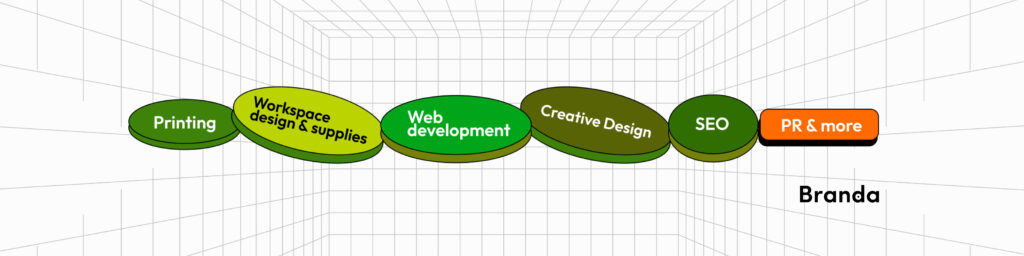
Branda approaches branding across the touchpoints that customers encounter before, during and after a purchase, from websites and digital experiences to printing, merchandise, packaging, corporate gifting and workspace solutions.
That matters because advertising rarely operates in isolation.
A campaign may bring the customer in.
But the rest of the brand has to give them a reason to stay.
The goal isn’t simply to get more people to notice your business. It’s to make sure more of them have a good reason to choose it.
Final Thought
Before you spend another million making more people aware of your business, ask a different question:
What exactly will they find when they arrive?
If the website is unclear, fix it.
If the message is confusing, simplify it.
If the experience is inconsistent, connect it.
If the packaging undermines the product, improve it.
If your team can’t deliver the promise, strengthen the operation.
Because advertising is an amplifier.
It can amplify what’s working.
It can also amplify what’s broken.
Make sure your brand is ready for the attention before you pay to create more of it.
Build the Brand Before You Scale the Attention
Branda helps businesses strengthen the touchpoints that shape customer perception, from web development and printing to merchandise, packaging, corporate gifting and workspace solutions.
Before you spend more to get noticed, make sure what people discover is worth remembering.
Lorem ipsum dolor sit amet, consectetur adipiscing elit. Ut elit tellus, luctus nec ullamcorper mattis, pulvinar dapibus leo.