


₦0
From Logo to Lobby: How a Brand Travels Through the Real World

A logo can fit neatly inside a presentation.
A brand cannot.
You can place an identity on a screen, print it on a business card or save it inside a brand guidelines document. But the moment a customer encounters the business, that identity begins to move.
It appears on the website they visit.
The email they receive.
The proposal they open.
The sign they see outside the building.
The reception area they walk into.
The packaging they take home.
The gift they receive after a meeting.
The experience they have with a member of staff.
A brand is constantly travelling between these moments.
And the further it travels, the more important consistency becomes.
A brand is more than what people see on a screen
For many businesses, branding still feels like something that lives primarily in the visual identity.
There is a logo.
There are brand colours.
There may be a particular typeface, photography style and set of guidelines.
These things matter. They create recognition and give the business a visual language.
But customers rarely experience a brand by looking at its logo in isolation.
They encounter the business in context.
They might first discover it through a website, then receive an email, visit the office, speak to a salesperson and eventually receive a product or service.
Each of those moments adds another layer to their perception.
The logo may introduce the brand.
The experience gives it meaning.
From identity to experience
The interesting part of branding begins when the identity leaves the page.
Consider a company that positions itself as modern and sophisticated.
Its website is clean.
Its visual identity is polished.
Its marketing materials are beautifully designed.
Now imagine a potential client visits its office.
The reception desk is cluttered.
The signage is inconsistent.
Printed materials use outdated versions of the logo.
The environment feels disconnected from the digital experience.
Nothing is necessarily wrong with the individual elements.
But they tell different stories.
The customer has moved from one brand environment to another, and the brand has lost some of its coherence along the way.
This is one of the reasons businesses can look impressive in one channel and surprisingly ordinary in another.
The identity was designed.
The experience was not.
The journey from logo to lobby
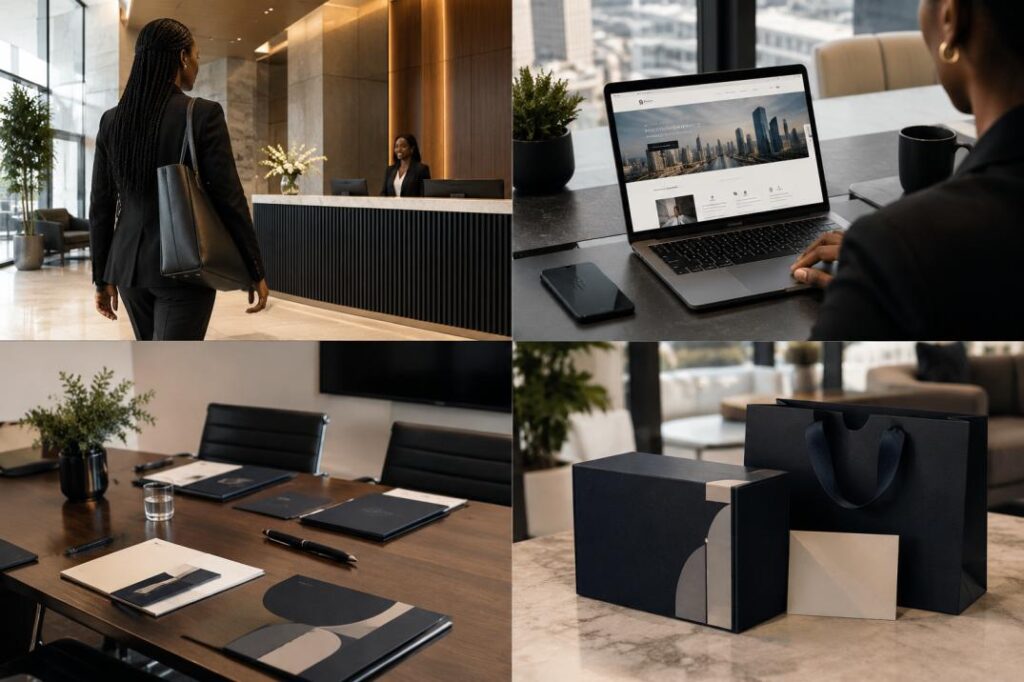
A brand can travel through dozens of touchpoints in a single customer relationship.
1. The first impression
Perhaps the journey begins online.
A customer sees a social media post or searches for the company and lands on its website.
Within seconds, they begin forming an impression.
Is this business established?
Is it credible?
Does it understand its audience?
Does it feel relevant?
The website is already doing brand work before anyone has spoken to the customer.
2. The conversation
The customer sends an enquiry.
Now the brand exists in a different form.
It is an email.
A phone conversation.
A WhatsApp message.
A proposal.
A presentation.
The tone, responsiveness and quality of communication can either reinforce the first impression or begin to weaken it.
3. The physical environment
Then comes the lobby.
The office.
The showroom.
The meeting room.
The signage.
The furniture.
The lighting.
The way information is presented.
The physical environment communicates things that a website cannot.
It can make a company feel established, innovative, welcoming, premium, practical or outdated.
The space becomes part of the conversation.
4. The handover
Perhaps the customer receives a product.
Now the brand appears on packaging, labels, printed materials or delivery materials.
The experience becomes tangible.
Something as simple as how a product is packaged can influence how valuable, thoughtful or professional it feels.
5. What remains afterwards
And sometimes the interaction continues even after the transaction.
A corporate gift sits on a client’s desk.
A branded notebook is used in meetings.
A product package remains in someone’s home.
A customer keeps an email or proposal for future reference.
The brand continues travelling long after the original interaction has ended.
The problem with designing each touchpoint separately
As businesses grow, different parts of the brand are often developed at different times.
The website may be redesigned by one team.
The office may be renovated years later.
Packaging may be produced by another supplier.
A marketing team may create new campaign materials.
A different vendor may handle corporate gifts.
Each project might be perfectly reasonable on its own.
But when placed next to each other, they may not feel like they belong to the same business.
This is where fragmentation begins.
A company doesn’t necessarily need everything to look identical.
In fact, excessive uniformity can make a brand feel rigid.
What matters is having a recognisable underlying language.
The same sense of quality.
The same personality.
The same level of attention.
The same understanding of who the business is trying to be.
Consistency is not about making every touchpoint look the same.
It is about making every touchpoint feel like it came from the same brand.
When the physical brand catches up with the digital one
There is a particular challenge for businesses that have evolved quickly.
Their digital presence may have changed dramatically while their physical environment remains stuck in an earlier version of the company.
A technology company may have a sophisticated website but an office that feels dated.
A premium consumer brand may have beautiful social media content but packaging that feels generic.
A growing professional services company may have developed a strong identity but still communicate through inconsistent documents and materials.
These gaps become more noticeable as businesses become more established.
The bigger the promise, the more carefully the surrounding experience needs to support it.
Your workspace is speaking too
One of the most overlooked parts of a brand journey is the workplace.
Businesses often think about their offices primarily in terms of functionality.
Where people sit.
Where meetings happen.
Where equipment goes.
But customers, partners and employees also interpret the environment.
A workspace can communicate precision or chaos.
Innovation or tradition.
Warmth or formality.
Confidence or uncertainty.
Even the smallest details can contribute to that impression.
The reception area.
Meeting rooms.
Signage.
Furniture.
Lighting.
Walls.
Wayfinding.
Branded environmental elements.
None of these should exist simply to “make the office look branded.”
They should support the kind of organisation the business wants people to experience.
That is when workspace design becomes more than decoration.
It becomes part of the brand.
The same principle applies to packaging and gifting
The brand journey does not stop at the office.
For product businesses, packaging may be one of the most important physical encounters a customer has with the brand.
For corporate organisations, gifting can become another moment of interaction.
A carefully selected gift, presented thoughtfully and aligned with the company’s identity, can communicate consideration and quality.
A generic item with a logo printed on it may technically be branded.
But branding is not simply the presence of a logo.
The question is whether the entire experience feels intentional.
What was selected?
How was it presented?
What does it communicate?
Would the recipient associate the experience with the brand even if the logo were removed?
Those are more useful questions.

What happens when the brand travels well?
When a brand is well connected across its touchpoints, something interesting happens.
The customer does less work.
They don’t have to wonder whether the website belongs to the same company whose office they are visiting.
They don’t have to question why the packaging feels completely different from the advertising.
They don’t have to adjust their expectations every time they move from one interaction to another.
Everything reinforces everything else.
The website prepares them for the conversation.
The conversation prepares them for the physical experience.
The physical experience reinforces the promise.
The packaging continues it.
The follow-up keeps it alive.
The brand becomes easier to recognise, not because every surface looks identical, but because every interaction feels intentional.
A brand should be able to move without losing itself
The strongest brands are not confined to one place.
They can move from a screen to a building.
From a building to a document.
From a document to a product.
From a product to someone’s everyday life.
And throughout that journey, something remains recognisable.
Not necessarily the logo.
Not necessarily the colour palette.
Something deeper.
A standard.
A personality.
A promise.
A way of making people feel.
That is what turns a visual identity into a living brand.
Because ultimately, customers don’t encounter your brand in a brand guideline document.
They encounter it in the real world.
From logo to lobby, from website to workspace, from packaging to the final handover, every touchpoint is another opportunity to tell the same story.
The question is whether your brand is telling one.
