


₦0
Your Next Customer Might Ask AI About You Before They Ask You

Imagine someone has never heard of your company.
They have a problem.
They need a service, product or solution.
Instead of opening Google and clicking through ten websites, they open an AI assistant and ask a much simpler question:
“Which companies can help me with this?”
The answer may give them a shortlist.
It may explain the differences.
It may mention customer reviews.
It may compare providers.
And it may recommend a company they had never heard of five minutes earlier.
That changes something important about the customer journey.
Your brand may now be introduced by a machine before it is ever introduced by your marketing team.
AI-powered search and answer engines are increasingly becoming part of how people research and evaluate businesses. Gartner reported in September 2026 that AI-powered answer engines are changing where customer demand forms, with people increasingly receiving answers without visiting a company’s website. HubSpot’s 2026 research similarly found that 42% of surveyed CRM buyers used AI search during vendor evaluation, with Buyers who used AI search during their evaluation as 36% more likely to make a purchase compared to those who did not.
The question for brands is no longer only:
“Can people find us online?”
It is becoming:
“What does the internet give AI to say about us?”

AI Doesn’t Know Your Brand the Way You Do
Your team knows the company.
You know what you offer.
You know your strongest projects.
You know what makes your business different.
You know the story behind the company.
An AI system does not have that internal knowledge.
It builds an understanding from information it can access.
That information can come from your website, published content, reviews, social platforms, news coverage and other third-party sources. HubSpot’s current guidance on answer-engine visibility specifically describes AI systems as drawing on a mixture of owned content, social media, reviews and third-party websites when deciding which businesses to surface.
This creates an interesting branding problem.
Your company may have a very clear understanding of who it is.
But if the public information surrounding the company is fragmented, outdated, vague or incomplete, an AI system may have less clarity to work with.
And that can affect how your business is represented when someone asks about it.
Being Online Is Not the Same as Being Understandable
A business can have a website.
Active social media.
A Google Business Profile.
A few articles.
Some reviews.
Maybe even press coverage.
Yet a potential customer could still struggle to understand what the company actually does.
This usually happens when businesses describe themselves differently everywhere.
The website says one thing.
LinkedIn says another.
Old articles describe services that have changed.
Third-party pages use an outdated description.
The company talks about itself using industry language that customers would never use themselves.
To a human who already knows the business, these differences may seem minor.
For an answer engine trying to determine what this company is, who it serves and when it should be recommended, they can create ambiguity.
This is why brand clarity is becoming more important in the age of AI search.
Not simply clarity in your messaging.
Clarity in the digital footprint surrounding your business.
Your Website Is Still Important, But It Is No Longer the Whole Story
This does not mean websites have stopped mattering.
Quite the opposite.
Your website remains one of the places where a business can clearly explain its services, expertise, projects and point of view.
But it is increasingly one source among many.
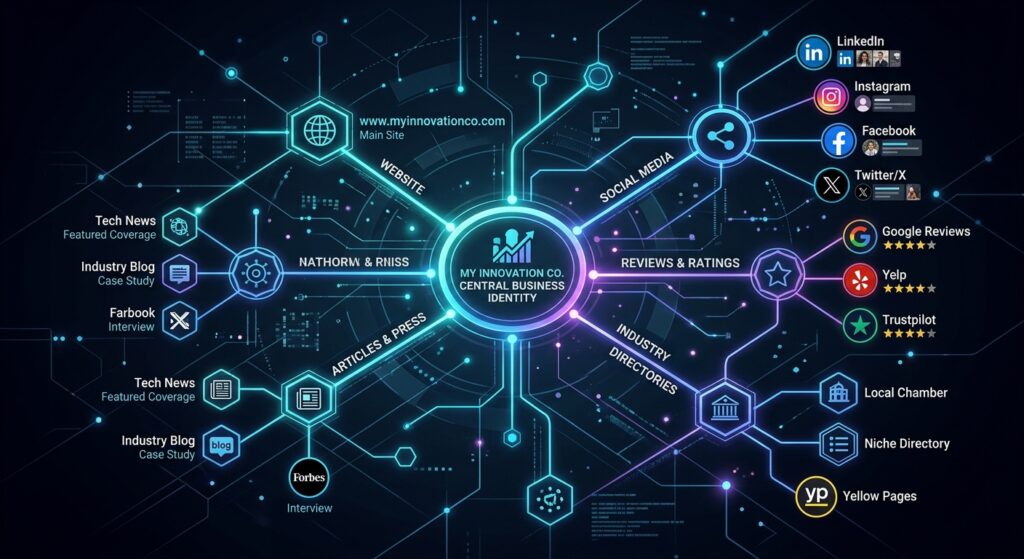
Think of your online presence as an information network.
Your website explains what you do.
Your project pages demonstrate what you have done.
Your social content shows what you think about.
Reviews reveal how people experience you.
Third-party coverage adds outside context.
Professional profiles establish credibility.
Industry mentions connect your company to the categories and conversations it belongs in.
When these pieces reinforce one another, there is a clearer picture of the business for both people and machines.
When they contradict each other, the picture becomes harder to interpret.
The New Discovery Question: Are You Recommendable?
Traditional search created a familiar goal:
Rank.
AI-led discovery introduces another question:
Recommend.
Those are not exactly the same thing.
A search engine can show someone a long list of results.
An answer engine can interpret the question and narrow the field.
That means a business may technically exist in search results without becoming part of the conversation that follows.
This is one reason traditional traffic metrics can tell an incomplete story. Gartner notes that as AI-mediated journeys absorb more of the discovery process, traditional measures such as clicks and website visits capture less of how demand is forming.
Imagine someone asks:
“Who are some branding companies that can help a growing business with its digital presence and physical brand experience?”
They are no longer searching for a single keyword.
They are asking for an interpretation.
And for a brand to appear in that answer, the business needs to be clearly associated with the problem being described.
That starts with how the brand is represented everywhere else.
This Is Where Your Projects Matter More Than You Think
There is an important implication here for businesses that already have years of work behind them.
Your project history is not just portfolio material.
It is evidence of what your company actually does.
A website saying:
“We create strategic brand experiences.”
is one thing.
A collection of clearly documented projects showing workspace design, print, digital development, manufacturing or corporate gifting gives that statement context.
The project tells the story.
The service provides the category.
The result provides evidence.
And the wider internet creates additional signals around it.
This is why documenting real work matters.
A completed project that disappears into an Instagram feed has less lasting value than one that is clearly explained, properly presented and connected to the wider story of the business.
Your past work helps define what people, and increasingly, AI systems, understand you to be good at.
What Happens When Someone Asks About Your Company?
There is a useful exercise every business can run.
Forget what your internal team thinks the company is known for.
Pretend you are a potential customer who has never heard of you.
Then ask a series of questions:
What does this company do?
Who is it for?
What problems does it solve?
What makes it different?
What evidence does it have?
What have other people said about it?
What kind of work has it actually done?
Then look at the public information available online.
Does it tell one recognisable story?
Or does someone have to piece the company together from six different places?
That exercise is useful whether your next customer comes through Google, social media, a referral or an AI assistant.
Because the underlying issue is the same:
Can someone understand your business quickly and confidently?

You Don’t Need to Predict Every Question
One mistake businesses could make with this trend is trying to write content for every imaginable AI prompt.
That can quickly become another version of keyword stuffing.
The more useful approach is to build a business that is well represented wherever customers might encounter it.
Explain your services clearly.
Keep important business information current.
Publish useful expertise.
Document real projects.
Encourage genuine customer reviews.
Make important pages easy to understand.
Build relationships and visibility beyond your own website.
Create content that answers the questions your actual customers ask.
In other words, don’t try to control every answer.
Give the internet enough accurate information to represent your business properly.
AI visibility is becoming measurable enough that platforms are now building tools specifically to track where brands appear in answer-engine responses and what sources those systems use. HubSpot’s AEO tools, for example, track brand mentions, prompt coverage and citation patterns across supported answer engines.
That signals a broader change in digital marketing:
Brand discovery is expanding beyond the places marketers have traditionally measured.
The First Impression May No Longer Be Yours
For years, businesses have invested heavily in controlling their first impression.
The website hero section.
The campaign.
The advert.
The social profile.
The sales presentation.
But there is another first impression emerging.
The one that happens when someone asks:
“Tell me about this company.”
You may not control the wording of the answer.
You may not control which sources are considered.
And different AI systems can produce different answers.
But you can influence the information ecosystem they encounter.
You can make your business easier to understand.
You can make your experience easier to verify.
You can make your work easier to discover.
And you can make the public story around the company much more complete.
That is increasingly becoming part of branding.
Not because brands need to start speaking to machines.
But because machines are becoming another route through which people encounter brands.
Final Thought
Your next customer may never begin with your homepage.
They may begin with a question.
And before they decide to visit your website, they may first ask AI what it thinks.
That makes every credible project, useful article, review, mention and clear description of your business more important, not as isolated pieces of content, but as parts of the story that surrounds your brand.
The future of discovery may not simply be about being easy to find.
It may be about being easy to understand, easy to verify and relevant enough to recommend.
What would an AI say about your brand today.
